Early Warning Signs: How the Dali Makes the Case for AI-Powered Risk Assessment

When the MV Dali lost power just three lengths away from Baltimore’s Francis Scott Key Bridge, it looked like a sudden catastrophe. The NTSB’s final report shows something different: a chain of small issues aligning at exactly the wrong time. A misapplied wire label kept a ferrule from seating properly in a terminal block. Years of vibration slowly degraded that connection until a critical control circuit opened and the ship blacked out, moments before striking the bridge. It’s a stark reminder of how fragile complex systems can be—and how early the warning signs often appear, if you know where to look.
Casualties like the Dali involve maintenance practices, operational decisions and shore-side infrastructure. The investigation highlights something every operator should care about: long before many mechanical failures, there are leading indicators.
Engine fires and mechanical blackouts almost always announce themselves before an event happens. Abnormal hotspots, mist, leaks, or smoke my not be immediately visible to the naked eye during a quick round. With FleetVision™, however, the picture is different. With the Technical Module, you see the early stages of risk that take ships offline and put crews in harm’s way.
FleetVision’s Technical Module uses thermal and visual data to catch the earliest, most subtle signs that something is changing in the machinery space. Rather than relying only on periodic handheld scans or waiting for traditional alarms, FleetVision employs fixed thermal cameras to watch over main engines, generators and critical equipment around the clock. The system continuously monitors surface temperatures on key components. When temperatures rise above a set threshold (e.g. 220°C), the system sends an alert to the crew.
But thermal imaging is only part of the picture. The same Technical Module also analyzes video feeds for smoke, mist and leaks. A fine spray from a fuel or lube line, a light haze building in a corner of the engine room, a small drip that begins to pool—these are the visual cues that often precede more serious incidents such as fire. Combined with thermal context, FleetVision helps identify problems that need immediate intervention.
All of this is tied into maintenance and history. Every anomaly FleetVision detects—thermal or visual—is logged with time, location and context. Engineers and superintendents can review these histories alongside work orders and inspection records, seeing not just what was done, but how the equipment behaved before and after. When something does go wrong, there is a richer data trail to support root-cause analysis and continuous improvement.
In practice, this changes the nature of engine-room awareness. Instead of occasional snapshots, you get a continuous, intelligent lookout focused on the early signals people often miss. FleetVision does not replace human judgment or good seamanship, but it does give crews and shore teams a better, earlier view of emerging risk which is exactly the shift the industry needs.
In a world where vessels are larger, schedules are tighter and machinery spaces are more complex than ever, relying solely on manual rounds and legacy alarms is no longer enough. Thermal patterns and subtle visual changes carry critical information about the health of your vessel. FleetVision’s Technical Module is designed to capture that information, interpret it and put it in front of the right people in time to act. For operators serious about reducing the risk of blackouts, loss of propulsion and engine-room fires, a system that can see heat signatures, smoke, mist and more in real time is no longer optional—it’s a must-have tool for modern maritime shipping.
Looking for more information on this topic? Download our Whitepaper: Seeing The Heat: AI-Powered Engine Fire Prevention with FleetVision™ Thermal Imaging
Maritime operations depend on engine reliability. As crews shrink and vessels grow more complex, you need a proactive warning system—not just another sensor. “Seeing the Heat” by ShipIn Systems reveals how integrating thermal imaging into your workflows transforms maintenance from reactive to predictive, keeps ships moving, and protects both crews and your bottom line.
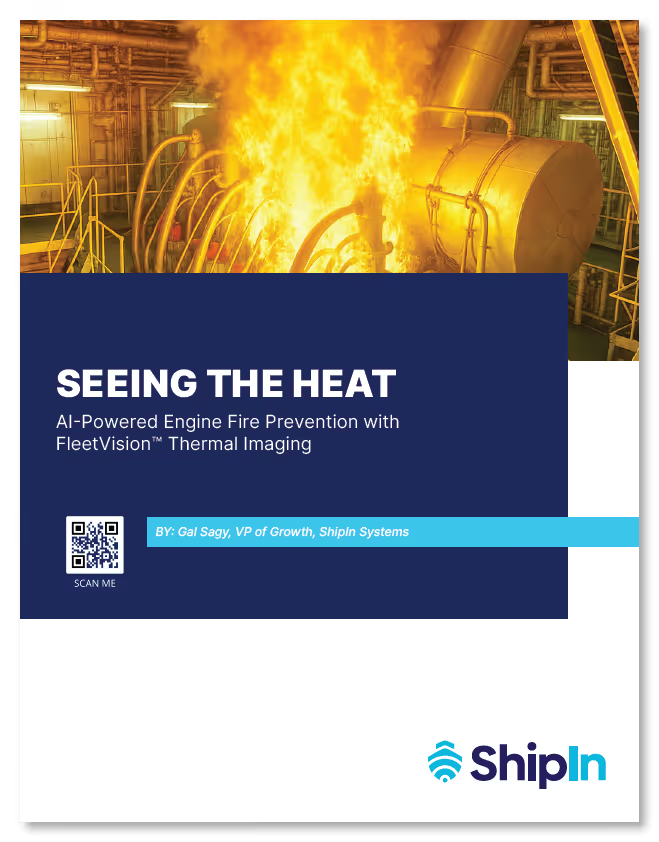
With this whitepaper you will learn:
- Why Traditional Inspections Fall Short
- How Thermal Imaging Changes the Game
- Real‑World Case Studies monitoring technologies
- Quantifiable Benefits
Download “Seeing the Heat” to discover how FleetVision’s AI‑driven Technical Module with thermal imaging helps you spot invisible warning signs, prevent costly breakdowns, and keep your fleet running safely and efficiently.